










インスタグラムをフォローする
アウトドア企業以上の存在

ソーヤープロダクツ
Follow us on Instagram




A guide to backpacking Bryce Canyon National Park's Under-the-Rim Trail and Riggs Spring Loop.
Watch videoOne of the nation’s smallest national parks, 56.2-square-mile Bryce Canyon National Park in south-central Utah isn’t really a canyon in the usual sense. Comprised of a series of more than a dozen horseshoe-shaped chromatic limestone amphitheaters on the eastern edge of the Paunsaugunt Plateau, it’s a wonder of wind and rain erosion that has resulted in a maze of slot canyons, windows, and spires. Bordered on the rim by ponderosa pines, high-elevation meadows, and fir-spruce forests, it’s a truly awe-inspiring place to backpack.
Combine the 23 miles of the point-to-point Under-the-Rim Trail with the 8.8 miles of the Riggs Spring Loop Trail at the end, and enjoy 31.8 miles of what is often called some of the world’s best air quality. Besides making it easier on the lungs, clean air also means easier on the eyes. You can literally see for 200 miles across a panorama of three states. It also means that on a clear night, the lack of light pollution provides unparalleled stargazing.
Continue reading to learn more about backpacking Bryce Canyon, written by Dave Collins.

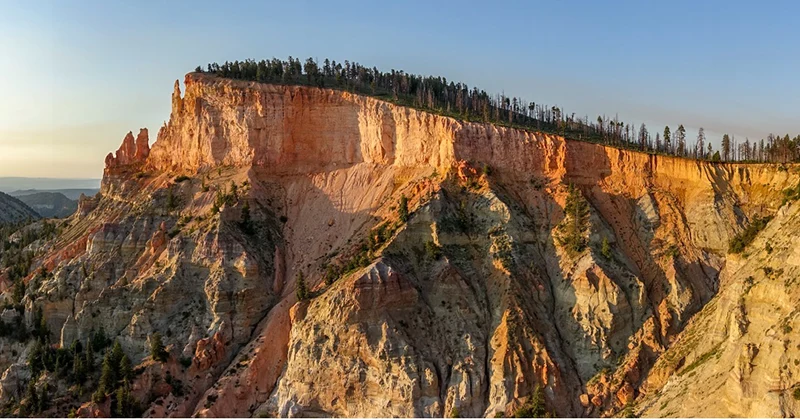
One of the nation’s smallest national parks, 56.2-square-mile Bryce Canyon National Park in south-central Utah isn’t really a canyon in the usual sense. Comprised of a series of more than a dozen horseshoe-shaped chromatic limestone amphitheaters on the eastern edge of the Paunsaugunt Plateau, it’s a wonder of wind and rain erosion that has resulted in a maze of slot canyons, windows, and spires. Bordered on the rim by ponderosa pines, high-elevation meadows, and fir-spruce forests, it’s a truly awe-inspiring place to backpack.
Combine the 23 miles of the point-to-point Under-the-Rim Trail with the 8.8 miles of the Riggs Spring Loop Trail at the end, and enjoy 31.8 miles of what is often called some of the world’s best air quality. Besides making it easier on the lungs, clean air also means easier on the eyes. You can literally see for 200 miles across a panorama of three states. It also means that on a clear night, the lack of light pollution provides unparalleled stargazing.
Continue reading to learn more about backpacking Bryce Canyon, written by Dave Collins.
アウトドア企業以上の存在

